
All wars have their own sounds, but in their aftermath they all sound the same. While cries and screams have been a constant, the noise of war has changed from the whizz of arrows to the clash of metals, the charging of cavalry, the roar of cannon and gunfire, the explosion of bombs, to the insidious buzz of drones. All those battles then ended in silence. Once the bodies had been plundered and buried, once the weapons had been dragged away to the next conflict and the armies had marched off, stillness returned. The land was tilled once more. Birds sang. Centuries later, visitors would come with a guidebook in hand and try to imagine how such peacefulness could have hosted such mayhem.
So it is with Flodden Field. Next to the village of Branxton in Northumberland, close to the Scottish border, is a low hill. A monument overlooks the surrounding countryside, bearing the simple words ‘Flodden 1513 – To the brave of both nations – Erected 1910’. In the valley below and the hill beyond was fought one of the key battles of British history. It was here, on 9 September 1513, that the English army under the Earl of Surrey destroyed a Scottish army, wiping out much of the governing class of Scotland and killing its king, James IV. It was the last medieval battle fought on British soil; the last battle in this country where the dominant sound was the clash of metal (there was cannon fire too), along with those cries and screams. It was, arguably, the first battle of a new media age.

The Battle of Flodden occurred because Scotland’s King James IV had signed an alliance with France. When King Henry VIII of England launched a campaign against the French, James felt obliged to invade England. His army of some 30,000 crossed the border over the River Tweed, though desertion had reduced the number from the likely original figure of 40,000. They razed a few castles, eventually positioning themselves on Flodden Hill, before repositioning themselves westward at nearby Branxton Hill. Surrey, declining to assault such a strong position, instead made an inspired flanking manoeuvre, heading north then round again so that the English, now looking south, faced the Scottish from an opposing hill, nullifying the Scots’ positional advantage and effectively cutting them off from their homeland. The English army amounted to some 26,000 men, fewer than the Scottish army but with a far superior command structure. Scottish loyalties were towards clan leaders rather than the king, which together with a fearless but reckless fighting manner and unsuitably weaponry would spell their doom.
Battle began with cannon fire from both sides. The weather was dreadful, cold and with constant rain. At first the Scottish army seemed to have the advantage. A successful charge downhill by divisions of Borderers and Highlanders had resulted in English troops fleeing. Though these divisions then mysteriously withdrew, their action probably encouraged James in his foolhardy decision to dismount and charge downhill with his warriors end enter the fray. In the bog at the valley bottom there was a bloody melée, the fighters armed with maces, axes, knives, bludgeons, bow and arrows, billhooks and – fatefully for the Scots, whose hazy strategy depended on them – long pikes which proved useless in such conditions. Cannon fire and arrows rained down upon them. In the mud and chaos, Scotland and its king were cut down. Up to 10,000 Scots may have died at Flodden, against some 1,500 English, in just two hours. With much of its aristocracy gone, along with thousands of able-bodied, men, Scotland entered a period of chaos and trauma. It would be thirty years before the country was ready to fight the English again. Of course, ninety years after Flodden a Scottish king, James VI/I, would gain the English throne, but history is made of such ironies.

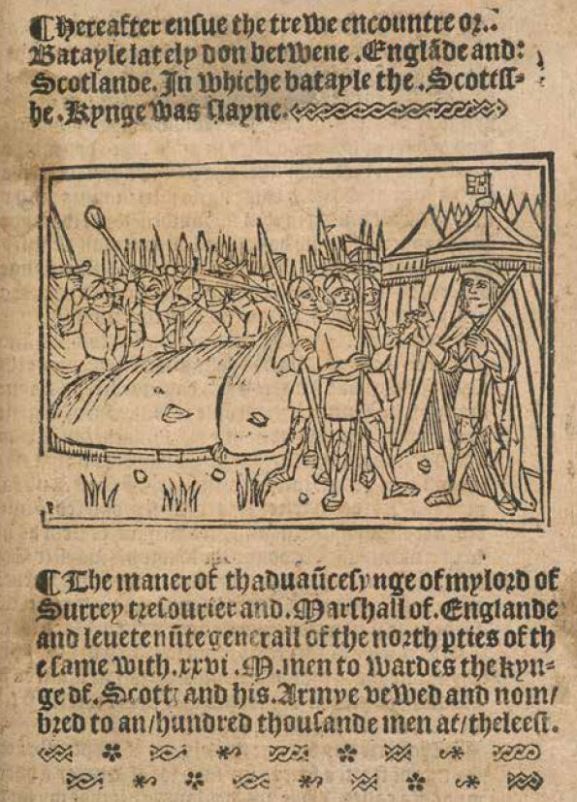
The news spread about Flodden, as news must, but in a new way. The printing press had been introduced in Britain by William Caxton in 1476, and in 1500 his successor Wynkyn de Worde became the first printer to set up shop in London’s Fleet Street, a name eventually synonymous with newspapers. No one was thinking of newspapers in 1513, but what is the earliest surviving example of printed news in the UK is Hereafter enfue the trewe encountre or … Batayle lately don betwene Englâde and Scotlande (1513), a pamphlet printed by Richard Faques reporting on the Battle of Flodden. Handwritten news reports were produced for rulers and wealthy businessmen, but a printed news pamphlet was meant for wider circulation, to be read by whoever could read or could have someone read to them. The trewe encountre, with its fresh reporting, its illustration and its sensational headline – “In which batayle the Scottffhe Kynge was slayne” – make Flodden feel unexpectedly modern.
Who knows the news of Flodden today? It’s a name that few seem to have heard of, and many of those who know the name would struggle to put a date to it, identify its causes, or to locate it. They should come to Northumberland, to Branxton, where the story of the battle is presented in exemplary fashion – informative and respectful. On arriving at the village your first port of call must be the visitor centre. They claim that it is the world’s smallest, something that seems hard to challenge, since it occupies a red telephone box. Apparently a gimmick, but in reality quite useful, it packs a lot of information into its small space, with maps, an audio guide and leaflets.

From the phone box you pass on to the church of St Paul’s, where the body of James IV is said to have lain after the battle. Little survives of the church from that time, as it was extensively rebuilt in 1849, but the church itself is an exquisite delight, gracefully and harmoniously designed. Its gentleness in the face of time prefigures the battlefield experience that is to come.

You proceed up a track to the monument, located at what was probably the centre of the English line at the start of the battle. The battlefield route, marked by clear and helpful information boards, first leads you down into the valley where the main fighting took place. Here is where the Scottish pikers, newly trained by the French in the use of these five-yard-long spears, found themselves caught in a boggy mess, their weapons useless in such close fighting once their formations collapsed. It was here that the English, armed with billhook blades, easily cut down the Scottish pikes and slaughtered them in their thousands.

You next go up the opposing Branxton Hill, where the Scottish troops were arrayed, a position of advantage that they surrendered for reasons no one quite understands. Those who laid out the route would seem to have touchingly planted clumps of thistles at this point where the Scots would have been looking northwards, towards Scotland, with the English army in between. It is a deft gesture to which no notice board refers, yet it is the battlefield’s most poignant spot. The tour then takes you back round to Branxton village.

At all points you are struck by the extraordinary tranquility of the place. The land has been given over to farming, birdsong fills the air, and any major roads are far away. The countryside gently undulates, adding to the sense of a world at peace with itself. Flodden battlefield is like a slow sigh, a breathing out after a couple of hours’ madness five hundred years ago. You must sense the war, because the boards tell you what happened and where. You learn all you need to learn of the bloodiness, the passion and the folly. But that is not what you feel and see. All about you is history’s closure. The past was noise; its necessary legacy is silence.

Links:
- Remembering Flodden & Border Heritage maintains a fine website, http://flodden.org.uk, which provides a good history of the battle and recreates the battlefield tour, with all of the information board texts and their illustrations
- There is a thorough long history of the battle on BritishBattles.com
- There are photographs of Branxton and Flodden battlefield on my Flickr site

Thank you for the wee history lesson. Beautifully, poignantly written.
Thank you. The intention is to capture the feeling, somehow.