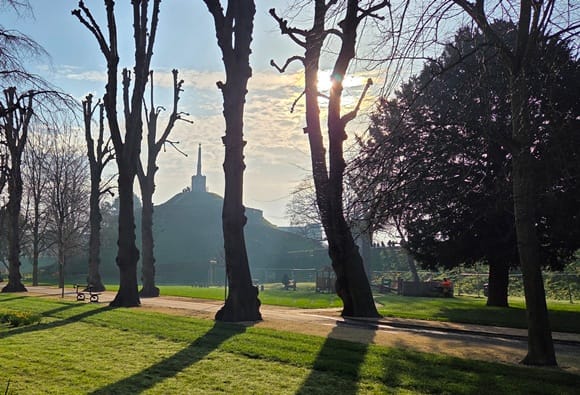
It’s time for another day in Canterbury. Since taking up care of a senior person resident in the city there have been many days spent here. On the train down I am close to finishing Walter Miller’s A Canticle for Leibowitz, the classic science fiction novel that literary types allow themselves to read. Its story is that of a monastery which keeps alive a culture that it no longer understands (circuit diagrams revered as holy texts), while the outside world rises and falls through successive nuclear disasters, until some take off for new worlds. Its theme is the cyclicality of history. We can only ever repeat ourselves… but the train is here. It is a cool Spring morning. Or else a warm one.
Any Ancient Roman arriving in Canterbury today would see familiar things. Were they to come via Canterbury East station then looming up in front of them would be Dane John, a grassy mound with paths leading up to a monument on top. Mirum est videre ibi, they might well say (“how surprising to see that still there”). What was once a Roman burial mound was turned into a castle by the Normans and into the centrepiece of public gardens by the Georgians.
They would admire the walls too – clearly augmented by subsequent generations, but still defining the shape of the city they knew, still keeping out the barbarians, who relentlessly circle the walls via the ring road in their horseless carriages, desperate for a way in.

Care of a senior person? What is going on? I am old enough myself for my age to be mocked by The Beatles.
Canterbury is a time machine. One senses each and every age simultaneously, in its variety, its unevenness, its untidiness. An olde Citie, somewhat decayed, yet beautiful to behold, so the sixteenth-century writer and city resident John Lyly described it. It has always been what it is.

The humble castle is wrapped in scaffolding. Opening late in 2026 says a notice, which makes you smile.
The Tannery area is filled with bijou homes, comfortably nestled in a quiet corner by the river. I am senior enough to remember when the Tannery was a tannery. When the wind was in the wrong direction the reek of it made you want to flee the city.

St Mary de Castro gardens, so pretty in the early morning, where a church was built in 618. By the seventeenth century it had disappeared, fallen into nothingness. They do not know where it was, but passing through we know that something of it lives on.
An elderly couple creep along the outside of houses leading into Castle Street, clinging like spiders. Each step is perilous, the walls offering little purchase. They inch their way to the corner, where passers-by guide them to the nearby coffee shop that is their goal.

Down Castle Street to Watling Street, backbone of the nation, created by Ancient Britons and paved by the Romans. Here the Three Tuns would make our Roman look again. It is a 15th-century pub built on the site of a Roman theatre, first constructed in AD 80. Its ruins lie below, biding their time.

Down Beer Cart Lane, past the elegant Chaucer Bookshop, your very idea of what a second-hand bookshop should look like. Everything within is beautiful as only books can be.
Along Stour Street, where Christopher Marlowe once walked (he was witness to a will here). I never fail to walk down here and feel that I am in his company. His word burn with truth and feeling:
FAUSTUS. Where are you damned?
MEPHISTOPHILIS. In hell.
FAUSTUS. How comes it then that thou art out of hell?
MEPHISTOPHILIS. Why this is hell, nor am I out of it

Here is the Poor Priests’ hospital. I worked there once, decades ago, when the 14th-century building was being turned into a museum. We would sit out the back in our lunch hour and watch the River Stour flow by, starting out on we knew not what in our lives. The museum closed in 2017, having never found much of a purpose or an audience. Now the plans are to redevelop it as a theatrical space with the teeth-grindingly awful name of the Marlowe Kit (it’s a pun – Christopher Marlowe was known as Kit).
Crossing the pedestrianised High Street, which slices through the circle of the walled city. People walk along it at speed, on their way to their various workplaces.
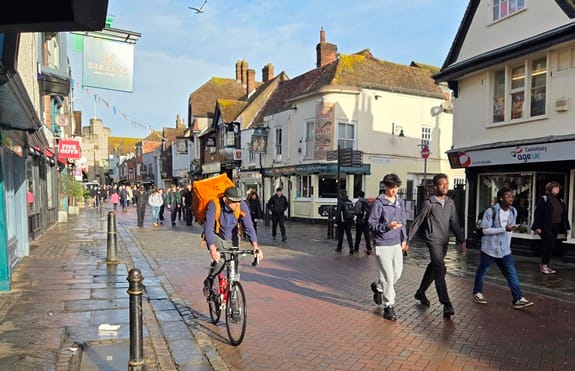
Down the side streets that weave around the cathedral. The life of the city is its its mazy thicket of medieval roads that hang off the high street, each one an adventure in time.
Police with heavy guns amble along the cobbled paths of Sun Street, a plaque for John Lyly above them. A new archbishop is being enthroned, a female one at that. What would once have shaken the earth now leaves not a tremor. Some crowds gather, rather more head for the coffee shops.
Food delivery bikes with L plates hum in every direction.
Time spent with the senior person, cleaning and tidying and cooking, listening to the diminishing memories mixed up with the haze of today. Now and then are one and the same, much like the city.
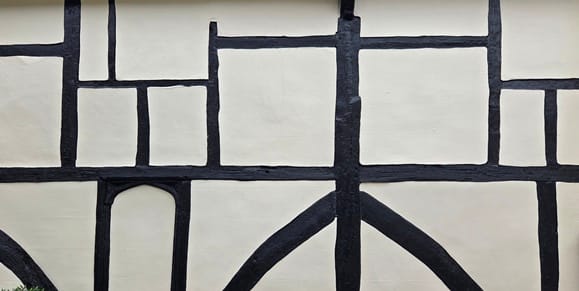
After lunch, the tour of the city continues. Prodigious waves of continental school children command the streets. They clutch boards with which they are expected to note down their fascination with a past that must mean nothing to them. Teachers and guides point to the city of centuries past, obvious to the present that throbs all around them.
Some of the children sport face masks. There has been a meningitis outbreak that began in a nightclub, throwing the city into the national headlines. It attacks the young. One of those who has died went to my old school. It makes the sorrow hit all the harder.
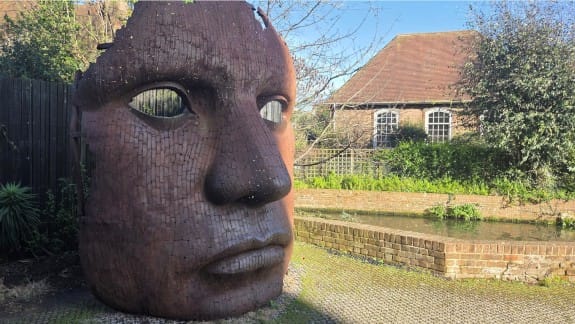
A giant mask glowers outside the Marlowe Theatre, perhaps resentful that here the dramatist is more acknowledged than seen.
Plaques to past notables are legion. There ain’t half been some clever bastards, as Ian Dury put it. He once taught art in the city, then sang for us all. His blue plaque says that we live in memorable times too.

The peerless, ramshackle Oxfam second-hand bookshop, huge beneficiary of being in a city with two universities. What the academics off-load I am happy to pick up.
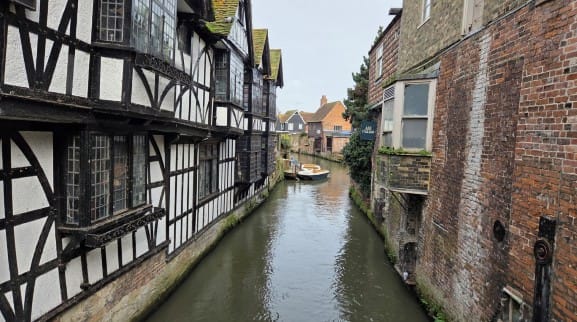
Crossing over the River Stour, which creeps wistfully by, half-hidden.
Heading up the High Street, a tale of two new statues. That of Geoffrey Chaucer is ingenious but somehow misses life. An anonymous man in bronze, refusing to look at us, holding up his poetry, while around his pedestal are the pilgrims of The Canterbury Tales, each with the face of a donor who help pay for this tribute to the city’s most celebrated literary figure. Its corporate nature nullifies the wit of the idea.

A few metres along, the city’s newest statue, that of Aphra Behn. The seventeenth-century poet, playwright, spy of sorts, and probably born near here, has her feet on the ground outside the Beaney, the city’s enterprising library, museum and gallery. She greets the passers-by with a frozen flourish. She is the one beside whom the young pose for photographs. They recognise her as one of them.
Rough sleepers make their homes in the porches of empty shops (of which there are many). They have been there for centuries.
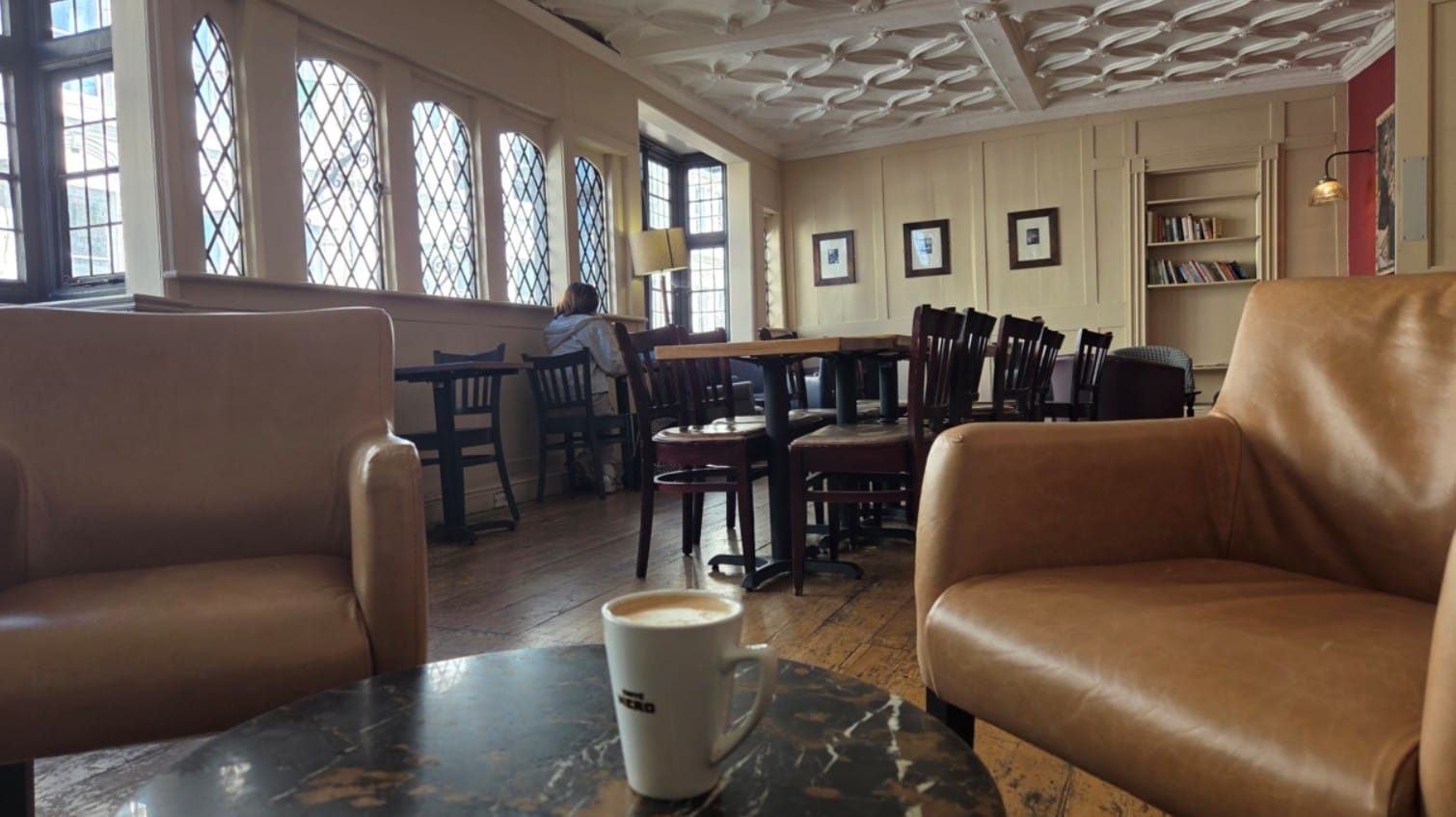
A pause for coffee at Caffe Nero. It’s an ancient building – upstairs is the Queen Elizabeth’s Guest Chamber. Here, it is said, Elizabeth (the first) met the Duke of Alençon, the person she came closest to marrying. He was twenty-four, she forty-six. It is a quiet haven. One senses that they have only just departed, leaving their half-drunk lattes behind them.
‘Don’t Think Twice, It’s Alright‘ plays softly over the speakers. Bob Dylan re-invented the singing voice, not just in his rawness but in its proximity to the truth. When the dust settles from our times, he may be all that survives.

Where are the grand stores of yesteryear – Ricemans, David Grieg, Nasons, Debenhams? For those of us who lived outside the city but came there for shopping, they represented the height of living. Now Ricemans is Fenwicks (a like-for-like transition), David Grieg is Superdrug, Nasons is an empty wreck in the middle of the High Street, close to the vast, deserted hulk of Debenhams, recently the victim of arsonists. One day the city may be nothing but ruins and coffee shops.
Buskers with speakers and cash machines. A bagpiper, an elderly male quartet trying to convince us that the Everly brothers are what matters, a guitarist who gets the rhythm of ‘Stuck in the Middle with You’ just right, the Sinatra clone’s amplified boom from which there is no escape.

A woman sits every day in the main shopping quarter with a table in front of her displaying paintings of Jesus of the Cecilia Giménez school. She wears a golden crown and has a microphone with which she sings along to religious pop. The voice is defiantly flat. She is there rain or shine. She seems popular, as fixed features tend to become.
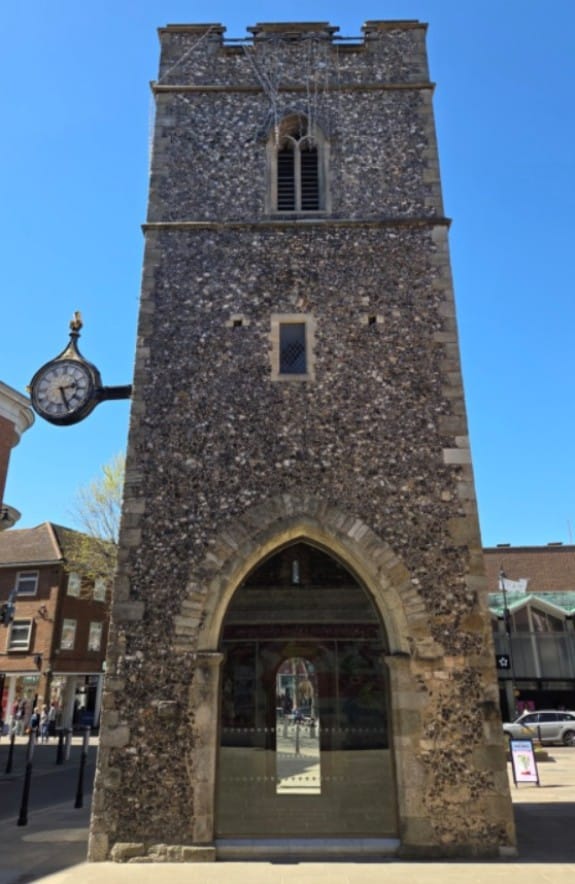
At the top end of the street, the church where Marlowe was baptised. Only the tower of St George’s survives. Here was the epicentre of the 1942 Baedeker raids on the city, German bombers off-loading on cultural places identified in the famous tourist guide. Here the city of old disappeared; the modern stores of Whitefriars fill the gap, reducing Canterbury to anywhere.
The primary target of the raids, the cathedral, had only minor damage, but nearby Butchery Lane was struck, with curious consequences. A Roman house was exposed, or partially so. Now you go down steps to an underground museum, the mosaic-ed floor undulating with the waves of time.
Under the city lies a city, waiting for who knows what calamity to fall, when it may rise up to reclaim its own. The past is always waiting for the time when we inevitably must fail.
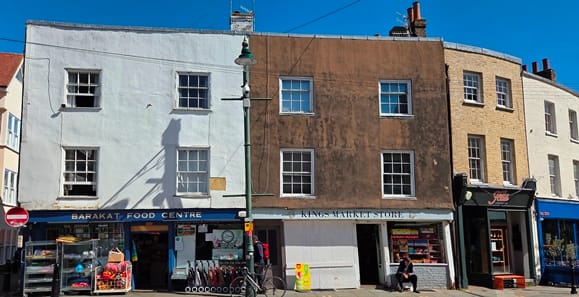
Back through the back streets, peopled by small shops clinging to the edges of the centre and to viability. Grocers, tattoo parlours, vape stores, hairdressers, snack bars, destined to be here and gone and forgotten by the time we wander past again.
And so to the senior person once more. We tackle jigsaws. Broken-up worlds we are compelled to rebuild. Hmm, thinks I, an interesting topic for a future blog post.
Supper time, the visitor’s day coming to its end. The light fades, leaving a ghostly haze. Saharan dust is the culprit, so it says in the news. Maybe it is a metaphor for something.

Back to the train. What am I reading now? Wolf Hall, nearly completed. A manual on how to make history.
Such is the day, or is it several days merging into one? It could have been early Spring or late Spring. Maybe it was the day of the virus, of the enthronement, of this busker or that, of sun, dust, or rain. Time is forever falling victim to memory.
What will happen in the future? asks the senior person. What will happen next year, and the next, and the next? Much the same nothingness until the spaceships arrive to take us away.
Links:
- There is plenty of information on the website of the industrious Canterbury Historical and Archaeological Society
- For an overview of Roman Canterbury see the Roman Britain site and the Canterbury Roman Museum site
- There’s a good illustrated guide on Explore Kent to Christopher Marlowe’s Canterbury, Literary Walks: Christopher Marlowe and Canterbury – A Circular Walk
- For more on A Canticle for Leibowitz and its view of historical recurrence, see Pedro Blas González, ‘A Canticle for Liebowitz and Cyclical History‘, New English Review (October 2020)
- Photographs of Canterbury from this post and plenty more are on the Canterbury album on my Flickr site

The smell from the tannery is an abiding memory of my time in the city. The place has changed since then – yet it is still the same.
Precisely so
What a wonderfully informed and warmly informative trip through the town, or city – and through time. I enjoyed the Dylan reference and the several nods toMarlowe. (Radio 3 has an interesting extended ‘essay’ on him: https://www.bbc.co.uk/sounds/play/m002vb8d)
And, for fun, here’s a letter I had published in the LRB recently:
Nuns in Leather
Michael Dobson notes that Christopher Marlowe has come to be seen as ‘an excitingly shady gay martyr’ (LRB, 5 March). I was reminded of an incident that took place in what must have been 1993, on the quatercentenary of Marlowe’s death, at St Nicholas’s Church in Deptford, the site of his unmarked grave. The afternoon’s celebrations, including a soliloquy performed by Antony Sher, were suddenly interrupted by the joyfully noisy arrival of a group of burly bearded ‘nuns’ in leathers and habits declaring themselves to be – banners and all – ‘gay bikers for Marlowe’.
Bob Jope
Torbay, Devon
Thank you. I shall listen to the Marlowe essay this evening. Dylan just happened to be playing in the coffee place and I made him fit. Dylan always fits. I’ve just come back from a walk down a Canterbury side street and someone was playing ‘Lay Lady Lay’ at full volume from a speaker on their bicycle. And guess who is in the window of the shop opposite? (see link below, because I can’t embed it) Dylan is everywhere.
https://www.flickr.com/photos/33718942@N07/55116728015/
Yep, everywhere. A friend of mine, a Prof at Berkeley, is seeing him there in June – Tim Hammond, by the way, is the author of one of the best books by far on Dylan’s writing: How the Songs Work. And this is me:
https://www.bob-jope-author.com/
The book’s two key characters are Dylan fans, one more onsessive than the other…
(Actually , my first book was Elvis in Wonderland.)
I spent my childhood in Kent (Isle of Sheppey) but know little of this important ‘citie’ in the County. In fact, when I hear ‘Canterbury’ I think of three things:
1. A St Christopher medallion my Mum brought back from a day trip there, apparently blessed in the cathedral but lost to me in the intervening 60 years.
2. Powell and Pressburger’s beautiful, intelligent ‘A Canterbury Tale’ with which I suspect you are extremely familiar.
3. Mum’s said day trips always involved a visit to the department store Ricemans, in which the England and KCCC legendary batsman Colin Cowdray’s family apparently had a significant interest.
Your lyrical piece here has made sure that I arrange a visit from my northern fastness ASAP and reclaim my Man o’Kentness – if such a thing exists!
Thank you as always Robert. I tried to work in A Canterbury Tale, which of course towards the end has haunting footage of Canterbury after the bombing, but I couldn’t pin down the still image I wanted. I also thought to work in the major stores of yesteryear – Ricemans, David Grieg, Nasons, Debenhams – which signified (for shoppers) the superiority of the city for so long. But the post was long enough.
I’ve decided to add a paragraph, with photo, on the stores of yesteryear, because it was always supposed to be there, only I forgot.
Really nice to be back. I used to spend my lunch hours wandering the cathedral cloisters.
If it weren’t just under £20 to visit the cathedral nowadays, I’d do so too